
Why Corporate Universities Fail to Secure Funding — And How They Can Become True Value Creators
For all the talk about "learning cultures" and "people development," corporate universities still face a stubborn and uncomfortable truth:
Most struggle to secure sustainable funding not because the business is short of budget — but because the academy fails to create visible, strategic value.
After 15+ years inside global organisations — from Pictet to Brunswick to Volvo — I’ve seen the same pattern repeatedly:
Brilliant L&D teams.
Strong intent.
Weak impact narrative.
And when value is unclear, funding becomes discretionary instead of non-negotiable.
This article explores why this happens, the four archetypes of corporate universities, and what it takes to evolve into a true Value Creator that shapes business performance, culture, and transformation.
1. The Four Archetypes of Corporate Academies
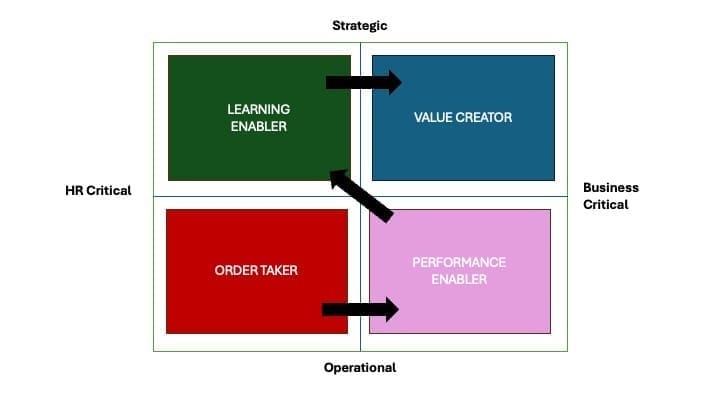
Every academy sits somewhere on two critical axes:
Strategic ↔ Operational
HR-Critical ↔ Business-Critical
When mapped together, four archetypes emerge.
1️⃣ Order Takers (Operational + HR-Critical)
This is where most corporate universities unintentionally sit.
Their mission is execution: Deliver training. Manage LMS. Respond to requests. Organise workshops.
They serve HR needs, not business priorities.
They execute, but they don’t influence.
Value created: perceived low
Funding risk: extremely high
2️⃣ Learning Enablers (Operational + Business-Critical)
More mature than Order Takers, these academies focus on capability frameworks, learning journeys, onboarding, and compliance. They support performance, but they remain reactive.
They enable learning but rarely shape transformation.
Value created: moderate but invisible
Funding risk: still high — value is not strategic enough
3️⃣ Performance Enablers (Strategic + HR-Critical)
This group begins to align with organisational strategy.
They develop leadership, culture, and talent pipelines. They influence internal mobility, succession, and behavioural change.
But without business metrics, they’re still seen as “HR investments” — not business engines.
Value created: meaningful but not measurable
Funding risk: medium
4️⃣ Value Creators (Strategic + Business-Critical)
This is the model every organisation thinks they have — but very few actually do.
Value Creators focus on:
business transformation
innovation and customer impact
operational efficiency and agility
sales performance and profitability
leadership effectiveness tied directly to business KPIs
They partner with the business like a strategic consultancy, not an administrative function.
Value created: high, tangible, measurable
Funding risk: minimal — this is where funding becomes self-justified.
2. Why Order Takers and Learning Enablers Struggle to Get Budget
The problem is not effort. It’s positioning.
Most academies are excellent at delivering learning, but weak at demonstrating value creation.
Three common challenges:
1. They speak the language of HR — not business.
Training hours. Completion rates. Attendance. LMS performance. Satisfaction scores.
These metrics do not move CEOs.
They don’t win budget battles.
2. They operate reactively instead of strategically.
When L&D behaves as a service provider, the business treats it as a cost center.
3. They lack systems to link learning to business transformation.
No learning analytics.
No capability dashboards.
No ROI frameworks.
The result?
A perception of “nice to have,” not “mission critical.”
3. What It Takes to Become a Value Creator
Transitioning to a Value Creator model requires a new identity and new capabilities inside the L&D function.
1. Speak Business, Not Training
L&D teams must understand:
business models
margin drivers
customer dynamics
operational challenges
market strategy
Research from McKinsey, BCG, and Deloitte is unanimous:
High-performing academies are those that anchor their work in business language and outcomes, not learning content.
2. Build Strategic Relationships with Senior Leaders
Value creation requires proximity. If the academy is not in the room where decisions are made, it cannot shape transformation.
A Value Creator model requires:
regular strategic reviews with EXCO
co-designing business priorities
embedding L&D in transformation roadmaps
3. Put the Right Learning and Performance Systems in Place
Tools matter — not for training delivery but for impact measurement.
Examples:
capability dashboards tied to OKRs
predictive analytics for talent and performance
skills intelligence platforms
business impact scorecards
This shifts the narrative from “We delivered 40 programs” to: “We accelerated revenue by X, increased internal mobility by Y, and reduced transformation risk by Z.”
4. From Training Hours to Transformation OKRs
A Value Creator academy does not measure success by volume. It measures success by business transformation.
That means shifting from output KPIs to transformation OKRs such as:
Increase innovation velocity — measured by time-to-market
Improve leadership effectiveness — tied to engagement, retention, and manager productivity
Accelerate digital transformation adoption — measured by process efficiency
Grow sales effectiveness — measured by conversion rates, win ratios, and client lifetime value
Strengthen organisational agility — measured by decision cycle speed
This is where corporate universities finally earn the right to command strategic investment.
5. Research: The Case for Value Creation
Multiple studies support this shift:
BCG (2024): Organisations that link capability building to business priorities outperform peers by 22–30% in profitability.
Deloitte Human Capital Trends: High-performing organisations measure L&D by business impact, not learning volume.
McKinsey: Companies that build strategic skills academies accelerate transformation success rates by 70%.
Case studies illustrate the transformation:
Example: A Global Bank (anonymous)
Their academy moved from compliance-heavy training to a value creation model:
built a leadership curriculum linked to transformation OKRs
aligned capability development with customer-facing priorities
created a skills intelligence platform
Result: +12% productivity in key business units and +28% trust in leadership.
Example: A Tech Organisation
By becoming a Value Creator:
reduced time-to-competence by 35%
improved sales ramp-up by 22%
increased internal promotions by 40%
These are the metrics CEOs invest in.
Conclusion: The Future Belongs to Value Creators
Corporate universities do not suffer from a funding problem.
They suffer from a value articulation problem.
Funded academies are those that:
operate strategically
align directly with business priorities
speak the language of value and transformation
build senior-leadership trust
demonstrate measurable business impact
If your academy is stuck in the Order Taker or Learning Enabler archetype, this is your inflection point.
The shift to Value Creator is not optional — it’s the new standard for survival and relevance.
If you’re leading a corporate university, talent function, or learning transformation and want to elevate your academy into a strategic, business-critical engine, let’s talk.
I help organisations redesign their corporate universities, clarify their value narrative, and build the systems and capabilities to become true Value Creators.
📩 Contact me to explore how your academy can secure funding, elevate influence, and deliver measurable impact.
Sign up for blog updates!
Join my email list to receive updates and information.
Copyright © 2025 Next Level Leaders - All Rights Reserved.



Copyright © 2025 Next Level Leaders - All Rights Reserved.